Get in touch - info@waavpafrica.org

Population genetics and genomics of Theileria parva in Zimbabwe and identification of vaccine candidates for January disease
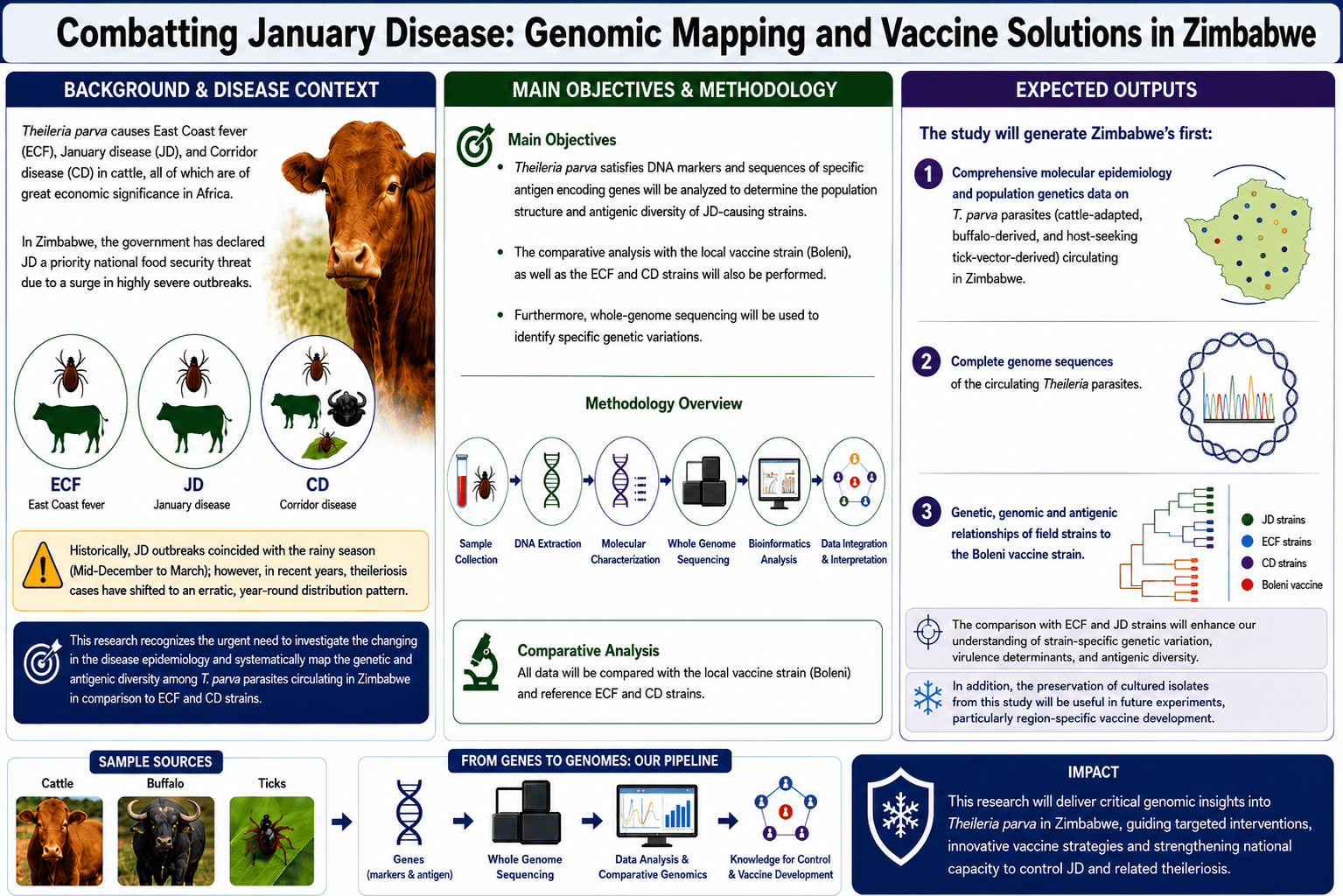
Theileria parva causes East Coast fever (ECF), January disease (JD), and Corridor disease (CD) in cattle, all of which are of great economic significance in Africa. In Zimbabwe, the government has declared JD a priority national food security threat due to a surge in highly severe outbreaks. Historically, JD outbreaks coincided with the rainy season (mid-December to March); however, in recent years, theileriosis cases have shifted to an erratic, year-round distribution pattern. This research recognises the urgent need to investigate the change in the disease epidemiology and systematically map the genetic and antigenic diversity among T. parva parasites circulating in Zimbabwe in comparison to ECF and CD strains.
Main Objectives & Methodology
Theileria parva satellite DNA markers and sequences of specific antigen-encoding genes will be analysed to determine the population structure and antigenic diversity of JD-causing strains. The comparative analysis with the local vaccine strain, Boleni, as well as the ECF and CD strains will also be performed. Furthermore, whole-genome sequencing will be used to identify specific genetic variations.
Expected outcomes:
The study will generate Zimbabwe’s first:
- Comprehensive molecular epidemiology and population genetics data on T. parva parasites (cattle-adapted, buffalo-derived, and host-seeking tick-vector-derived) circulating in Zimbabwe.
- Complete genome sequences of the circulating Theileria parasites
- Genetic, genomic and antigenic relationship of field strains to the Boleni vaccine strain
The comparison with ECF and JD strains will enhance our understanding of strain-specific genetic variation, virulence determinants, and antigenic diversity. In addition, the preservation of cultured isolates from the study will be useful in future experiments, particularly region-specific vaccine development