Get in touch - info@waavpafrica.org
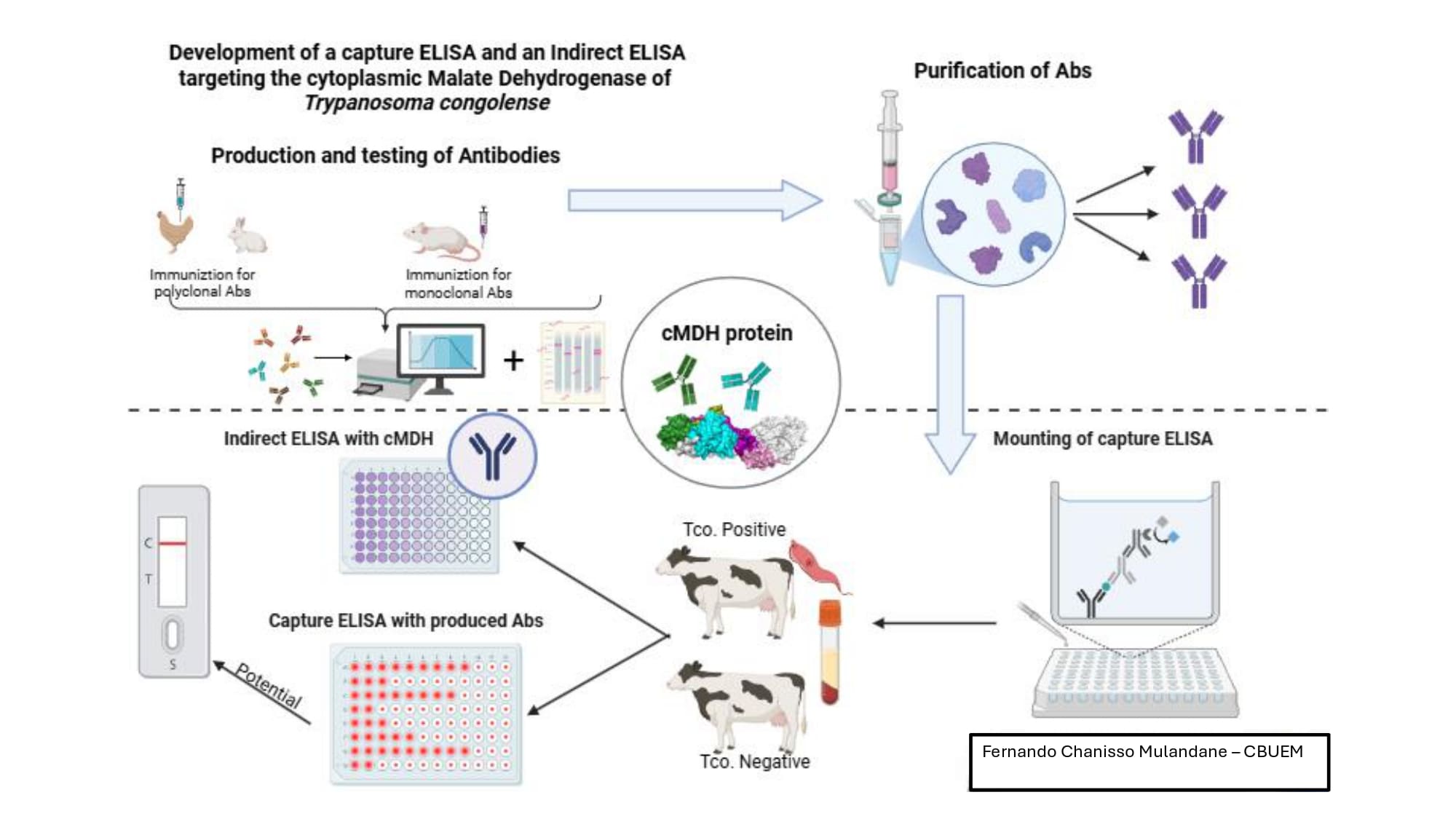
Development of a capture ELISA and an Indirect ELISA targeting the cytoplasmic Malate Dehydrogenase of Trypanosoma congolense
African animal trypanosomosis (AAT), also known as nagana, a parasitic disease caused by Trypanosoma congolense, poses a severe threat to livestock production and socio-economic development in sub-Saharan Africa. A lack of accessible, field-ready, and accurate diagnostic tools heavily hinders current control strategies. Existing field methods suffer from low sensitivity, while sophisticated molecular methods (e.g., PCR) are costly and bound to centralized laboratory infrastructure.
Furthermore, available serological tests target antibodies rather than active infections, leading to cross-reactivity and blind, indiscriminate drug administration that accelerates pathogen drug resistance. This project aims to bridge this diagnostic gap by leveraging the unique properties of the cytoplasmic malate dehydrogenase (cMDH) enzyme of T. congolense.
The research will develop two distinct diagnostic tools: (1) a proof-of-concept antigen-capture ELISA capable of identifying active infections, designed for future conversion into a thermostable, pen-side lateral flow device, and (2) a highly sensitive indirect ELISA targeting circulating antibodies against cMDH for large-scale epidemiological disease mapping.
By transitioning diagnostic capabilities from complex laboratories directly to remote, resource-limited livestock farms, this project will optimize veterinary resource allocation, slow the spread of drug resistance, and provide reliable baseline data to assess vector and disease control programs. Therefore, the expected outcomes from the present study include:
- Scientific and Socioeconomic – development of two important highly sensitive and specific serological tests.
- Publications: a) A new antigen capture ELISA for the diagnosis of Trypanosoma congolense infections and b) Development of an Indirect ELISA targeting cytoplasmic Malate Dehydrogenase for the diagnosis of Trypanosoma congolense in cattle.
- Attendance at international conferences.
- Master’s Dissertation: One master’s student will be enrolled in a master’s program and will develop research on the proposed subject.
- New Knowledge: New insights into the diagnosis of AAT.
- Capacity building: Technicians and researchers will be trained in basic concepts of serological diagnosis of AAT.