Get in touch - info@waavpafrica.org

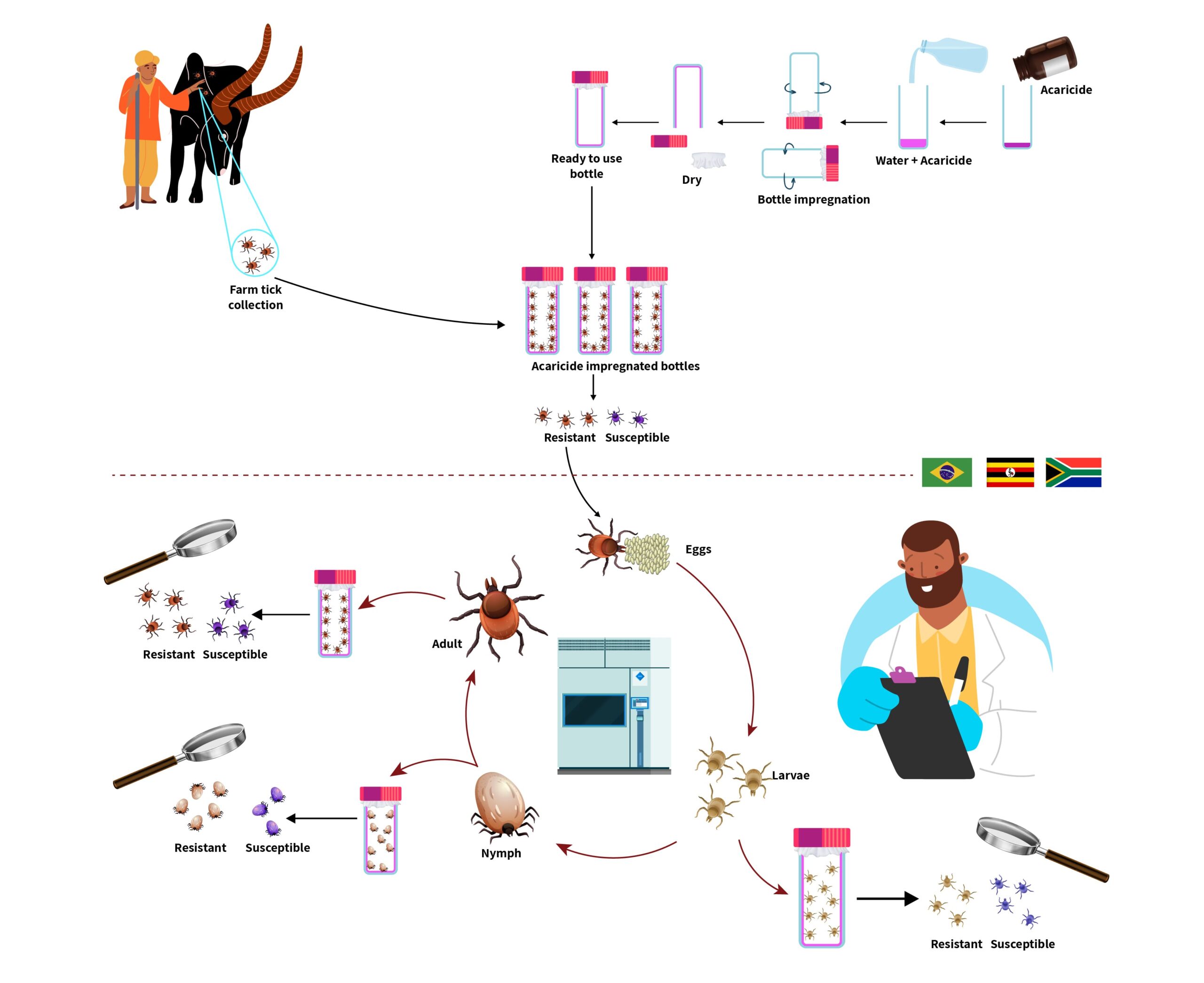
Assessing the Bottle Acaricide Impregnation Test (BAIT) assay effectiveness for monitoring acaricide tick-resistance from laboratory to farm-level
Ticks are blood-feeding ectoparasites that transmit a broad range of pathogens that cause diseases which significantly affect human and/or animal productivity. Although chemical-acaricide animal spraying is the first line for controlling ticks and tick-borne diseases, there is global concern about increasing acaricide tick resistance. Therefore, there is a need to regularly monitor the status of tick response to commercial acaricides.
Currently, the Food and Agricultural Organization (FAO) recommends several methods, namely the larval packet test (LPT), the larval immersion test (LIT), the microtube larval immersion test (m-LIT), the larval tarsal test (LTT), and the adult immersion test (AIT), of which LPT and AIT are the most commonly used methods. However, these methods are suited only for laboratory use. Additionally, each method is specific to a particular stage of the tick life cycle. The LPT is more costly compared to the AIT, and they both require highly trained personnel. Therefore, there is an urgent need for an alternative assay applicable at both field/farm and lab levels while yet addressing the limitations of the LPT and AIT.
In 2025, Ndawula and colleagues at the National Livestock Resources Research Institute (NaLIRRI), under the National Agricultural Research Organization (NARO) of Uganda, revealed a novel alternative assay name: the Bottle Acaricide Impregnation Test (BAIT), which is as proficient as the LPT and AIT, cheaper, applicable to ticks at all stages and has potential use at both lab and field/farm levels. The objective of this study is to determine the effectiveness of the BAIT assay to diagnose acaricide resistance among field ticks obtained from farms in at least three selected areas: Uganda, South Africa and Brazil. The findings will demonstrate the feasibility of applying the BAIT assay for monitoring acaricide tick resistance at the lab and field/farm level globally.