Get in touch - info@waavpafrica.org

Integrative Surveillance of Tick-Borne Pathogens in Ghana: Ecology, Genomics, and Public Health Risk
| Project Title | Integrative Surveillance of Tick-Borne Pathogens in Ghana: Ecology, Genomics, and Public Health Risk |
| Lead applicant | Dr. Jennifer Afua Afrifa Yamoah, CSIR-Animal Research Institute |
| Co-applicants | Dr. Believe Ahedor, Noguchi Memorial Institute for Medical Research, University of Ghana |
| Other project team members | Ms. Antoinette Keleve, CSIR-Animal Research Institute; Mr. Norbert Teye, Noguchi Memorial Institute for Medical Research, University of Ghana |
Project Summary
Rapid urbanisation, agricultural intensification, land-use change, and climate variability are reshaping tick distribution, host interactions, and pathogen transmission, increasing the risk of emerging and re-emerging tick-borne diseases in livestock and humans. Despite the economic and public health importance of these diseases, comprehensive data on tick ecology, pathogen diversity, and transmission dynamics in Ghana remain limited.
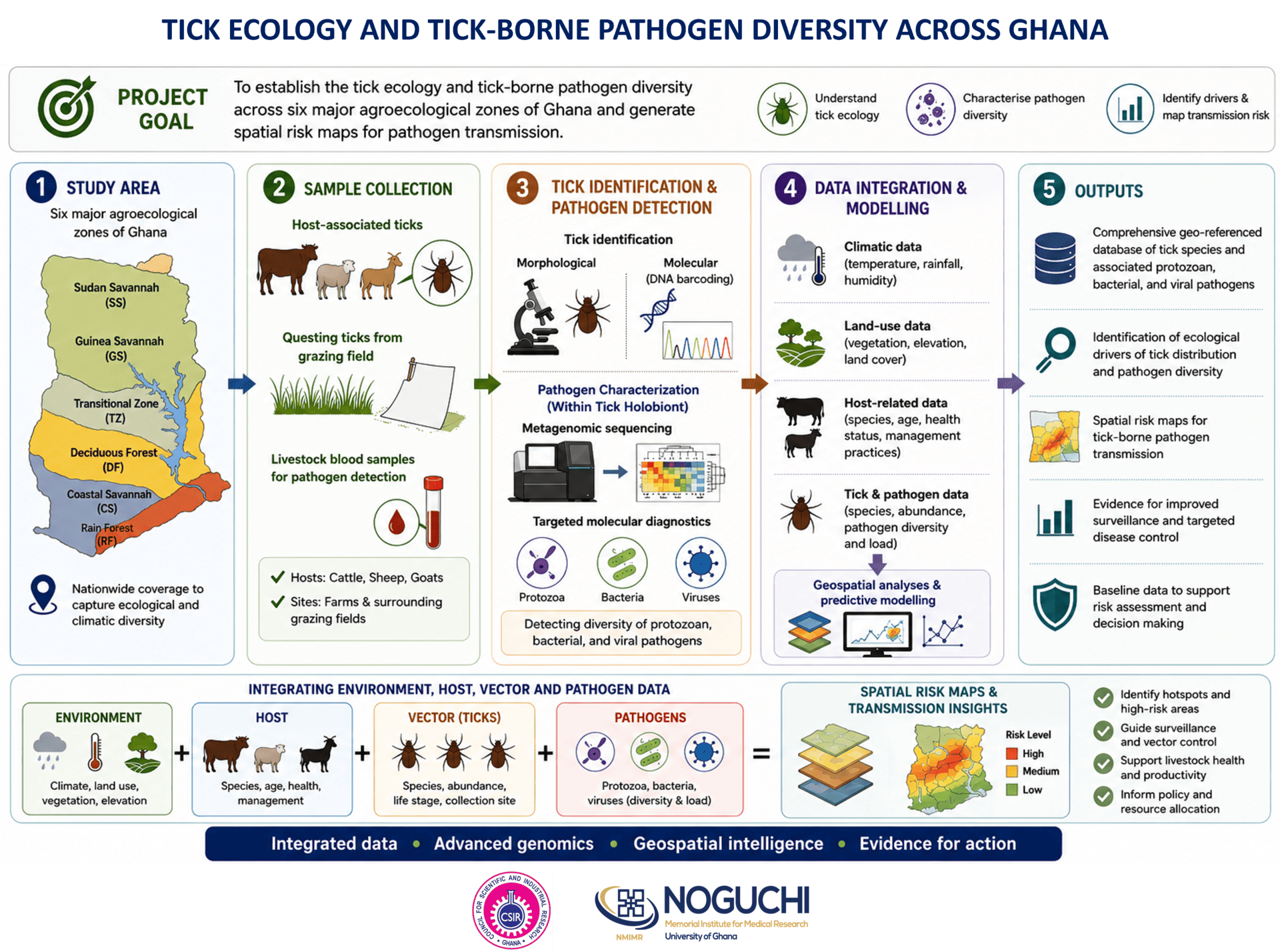
This project aims to establish the first nationwide baseline of tick ecology and tick-borne pathogen diversity across six major agroecological zones of Ghana using an integrated One Health framework. Host-associated and questing ticks will be collected from cattle, sheep, goats, and grazing field, alongside livestock blood samples for pathogen detection. Tick species will be identified using morphological and molecular approaches, while metagenomic sequencing and targeted molecular diagnostics will characterise the diversity of protozoan, bacterial, viral, and fungal pathogens within the tick holobiont. Ecological, climatic, land-use, and host-related data will be integrated with geospatial analyses and predictive modelling to investigate vector–host–pathogen–environment interactions, identify ecological drivers of tick distribution, and generate spatial risk maps for pathogen transmission.
The project is expected to produce a comprehensive geo-referenced database of tick species and their associated pathogens, identify transmission hotspots, and provide insights into ecological factors influencing disease emergence. These findings will strengthen national surveillance systems, inform evidence-based vector control strategies, and support the development of risk-based One Health policies for livestock and public health.